Cognitive Design: AI-Powered Concept Exploration Platform for Mechanical and Thermal Parts
The concept phase is the least equipped yet the most consequential phase in any engineering program. Cognitive Design was built to fix that.
Cognitive Design is the first platform that unifies generative design, real-time simulation, manufacturing constraints, and cost and carbon footprint analysis in a single concurrent workflow, enabling engineers in Aerospace, Space, Defense, and Automotive to explore 50 to 100+ qualified design variants before anyone opens a traditional CAD tool.
Why engineers choose Cognitive Design
Traditional tools force a sequential process: design first, simulate later, check manufacturability last. By the time all constraints are on the table, the concept window has closed. Engineers commit to the first geometry that fits the schedule, not the best one that fits the requirements.
Cognitive Design replaces this sequence with a parallel, exploration-first approach. Define your design space, load cases, material, and manufacturing process once. The platform generates dozens of structurally valid, manufacturable concepts simultaneously, each evaluated on mass, stress, cost, CO2, and manufacturability, each within 95% of the final part. The selected concept exports directly to traditional CAD tools via STEP or IGES. The downstream chain is unchanged.
Description
Core capabilities
Generative Design
Generate the highest-performing geometry for a single part, with full control and full traceability at every step.
Three generation methods: Topology Optimization (level set), Topology Weaving (stress-guided structural skeletons), and Topology Enclosure (conformal shells for housings and covers). Full engineer control over every parameter. Every iteration is visible, inspectable, and logged.
Simulation-Driven Design
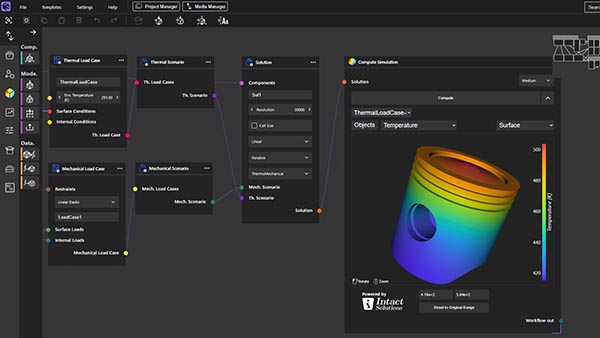
Real-time structural and thermal simulation embedded in the design loop. No meshing. No export. No waiting.
Meshless FEA runs in real time during generation. Structural and thermo-mechanical simulation are native in v2.1, enabling simultaneous evaluation of mechanical loads and thermal gradients in the same workflow.
Manufacturing-Driven Design
No more DFM back-and-forth. Manufacturing constraints are embedded in every generated concept.
DFM constraints for AM, die casting, 5-axis machining, forging, and injection molding are embedded in the generation loop, not applied after. The only platform that compares multiple manufacturing processes concurrently within the same design exploration.
Design Explorer
The environment where every generated concept is evaluated, compared, and selected on quantified criteria, not gut feel.
Every generated variant lands automatically in a multi-criteria dashboard with its full KPI set: mass, Von Mises stress, displacement, safety factor, cost, CO2, and manufacturability score. Engineers compare and select with data, not instinct.
Reusable Workflows
Capitalize engineering knowledge into auditable, repeatable, certifiable parametric templates. Cut part family development time by 7x.
The optimal workflow for a first part is captured as a fully parametric template, encapsulating all design logic, constraints, and solver settings. Every subsequent variant in the family is generated by updating input parameters only, with no rebuild and no starting from scratch.
First part: 2 weeks. Every variant after: 2 days. Engineering knowledge capitalized once, reused across every program. When a senior engineer leaves, the know-how stays.
Deterministic by design. Certifiable by default.
Every result in Cognitive Design is computed by deterministic solvers. Same inputs, same output, every run. No stochastic variability, no unexplainable results. Every design decision is logged with its full parameter history, making outputs auditable for certification and explainable in any design review.
AI adoption in Cognitive Design produces a return on investment you can calculate, not estimate. For classified and sensitive programs: full on-premise deployment, no data leaving the client environment.
Proven results
- 85% concept lead time reduction (Potez Aeronautique, Falcon 6X bracket)
- 50% mass reduction per bracket, 7x faster per variant across 80+ components (Thales Alenia Space)
- 85% Von Mises stress reduction, 96% displacement reduction (T4i, CubeSat propulsion tank)
- 30 to 45% average mass reduction across programs
- 40 to 60% reduction in physical prototype iterations
Customers include: Thales Alenia Space, Toyota, Liebherr, Orano, ARQUUS, Sodern, Sogeclair, T4i.
www.cognitive-design-systems.com